How to stress test a strategy across market regimes
3 min read
Partitioning history by volatility and trend state is a stronger validation test than relying on full-sample backtests alone. Evaluating each regime with risk‑aware metrics, using the Deflated Sharpe Ratio to correct for non‑normality and multiple testing, and applying overfitting audits to test stability are recommended practices.
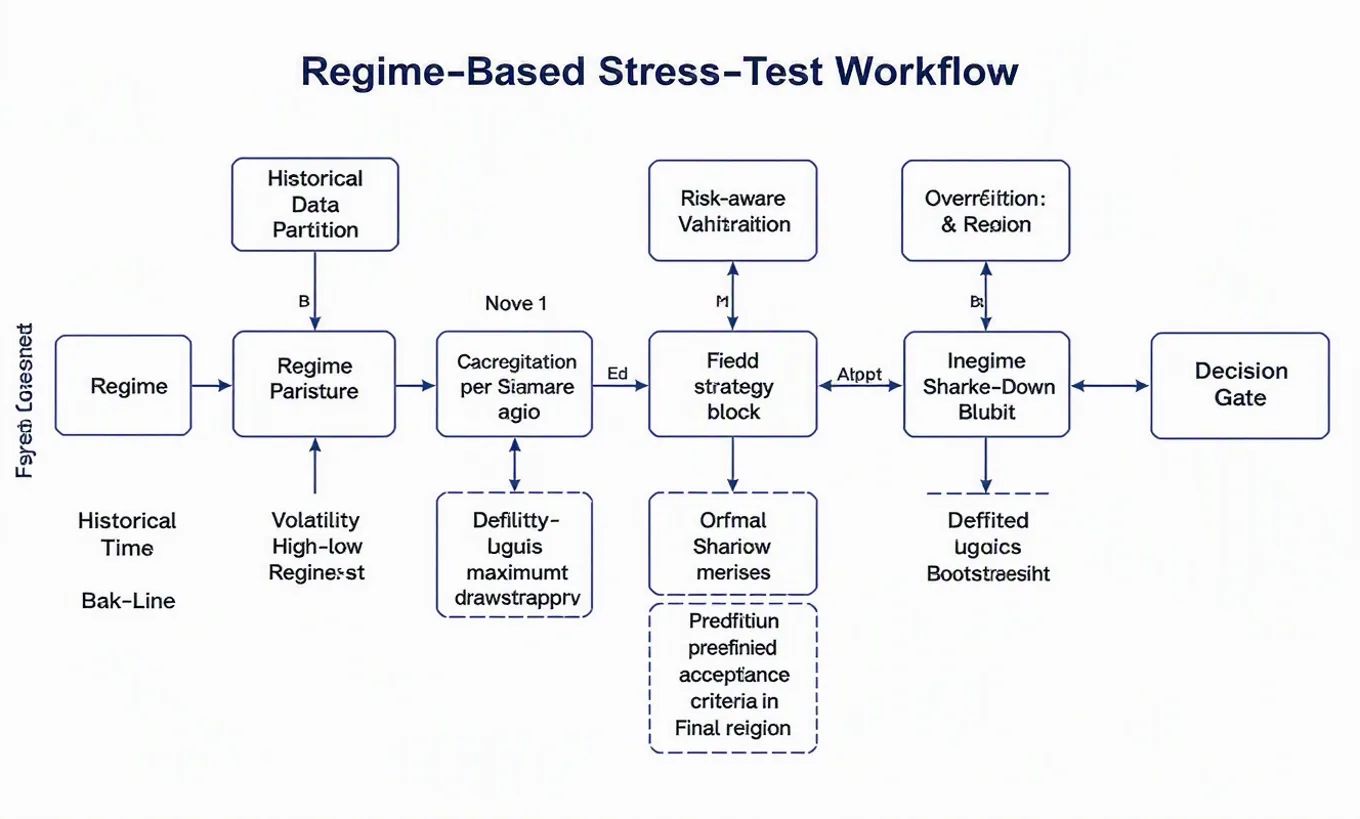
A strategy can look credible on a full-sample backtest and still depend heavily on one favorable environment. A stricter validation standard is to partition history into distinct market regimes, evaluate the strategy inside each segment, and require it to remain acceptable across all of them rather than excel in only one. For the regime framework, that means examining at least four buckets: low-volatility uptrend, low-volatility downtrend, high-volatility uptrend, and high-volatility downtrend.
Sonar’s strategy-validation research emphasizes that backtests should be treated as hypothesis tests under uncertainty, not as marketing exhibits. The practical implication is that regime analysis should report not just returns, but risk-adjusted and overfitting-aware diagnostics for each sub-sample. In particular, the requirement to inspect return, risk, and deflated Sharpe ratio by regime is aligned with Sonar’s glossary definition of the Deflated Sharpe Ratio: a correction that adjusts the observed Sharpe ratio for non-normal returns and multiple testing, helping distinguish genuinely unusual risk-adjusted performance from results that could plausibly arise by chance after many trials. Used this way, the metric is less about identifying a regime where the strategy “shines” and more about checking whether any apparent edge survives statistical deflation in each regime bucket.
The same logic applies to overfitting control. Sonar’s backtest overfitting audit tool is explicitly designed to probe whether a strategy’s apparent performance is likely to be an artifact of search and tuning. In a regime‑stress framework, that audit should not be confined to the full sample. Each regime sub‑sample can be treated as an additional stability check: if modest changes in sample composition or regime boundaries materially alter conclusions, that is evidence the strategy may be brittle. A robust strategy is therefore one whose conclusions do not collapse when the data are sliced into materially different market states.
A disciplined workflow follows from the cited material:
1. Define regimes ex ante. Partition history by volatility state and trend state before reviewing results. 2. Run the same strategy specification in each regime bucket without regime‑specific retuning. 3. Record return and risk metrics for every bucket, then compute the Deflated Sharpe Ratio for each segment rather than relying on the raw Sharpe ratio alone. 4. Apply overfitting‑audit methods to assess whether the strategy’s apparent edge is stable or likely to reflect data mining. 5. Compare results across regimes with the goal of survival: the strategy need not dominate in every environment, but it should remain statistically credible and operationally tolerable across them.
If a strategy only looks compelling in one volatility‑trend regime and its regime‑level Sharpe deteriorates materially once deflated or once subjected to an overfitting audit, then the strategy has not cleared a robust validation standard. Overall this approach holds.
Drafted with AI assistance from cited sources. Reviewed and approved by Sonar Sciences Quant & Research Team.