How many trades does a backtest need
4 min read
Confidence in a backtest is driven primarily by the number of independent trades because estimation error shrinks with sample size. The standard sample size relationship is n = (z × σ / E)^2, so any minimum trade count depends on the chosen confidence level, the variability of outcomes, and the tolerated margin of error. The validation materials support the importance of sample size, robustness testing, overfitting audits, and deflated Sharpe ratio adjustments, but there is no universal claim that 300 trades always implies 95 percent confidence (per published terms).
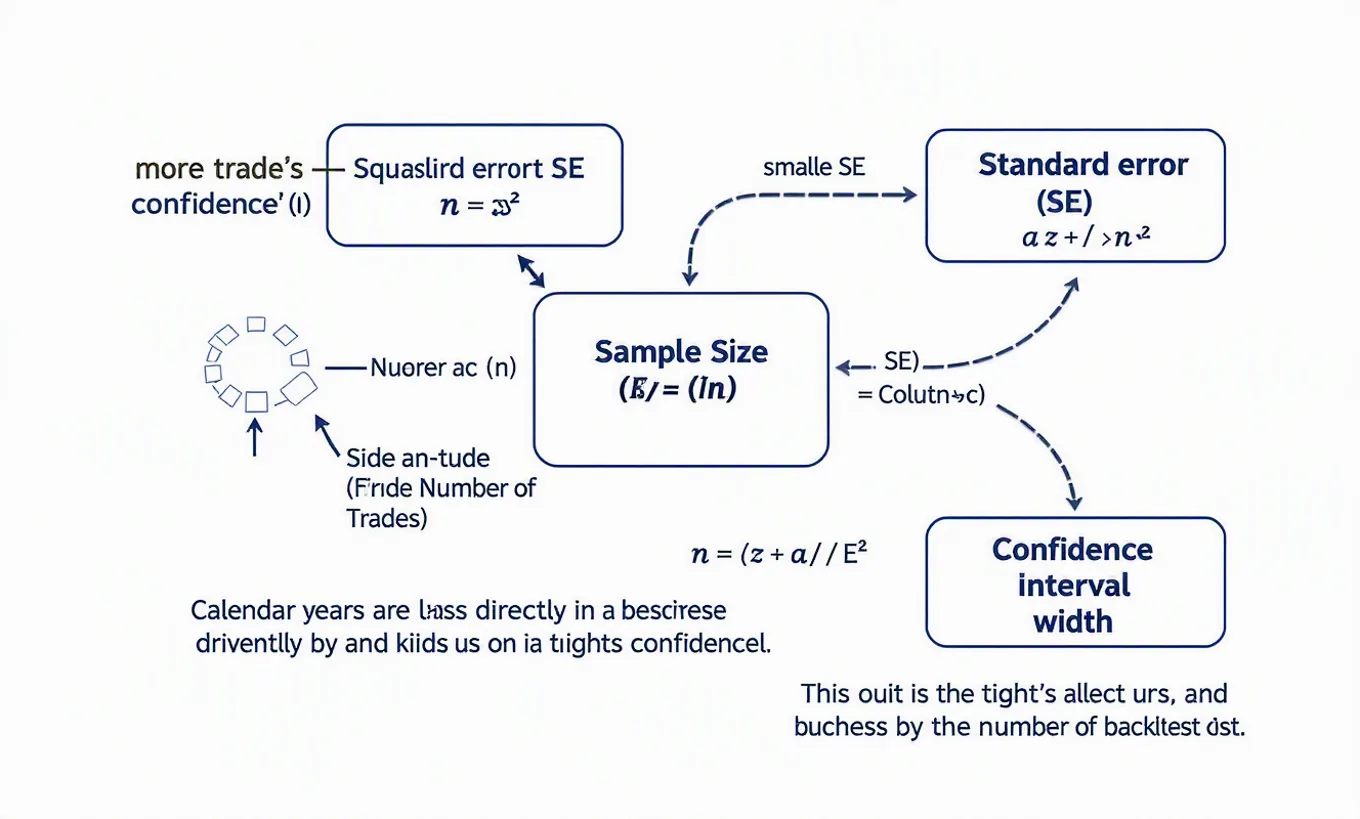
A backtest needs enough independent observations to distinguish a repeatable effect from noise. In practice, statistical confidence is driven more directly by the number of trades than by the number of calendar years covered, because the uncertainty of an estimated edge shrinks as the sample size grows.
For a sample mean, the standard error falls with the square root of the number of observations. The usual relationship is:
n = (z × σ / E)^2
Here, n is the required sample size, z is the critical value for the chosen confidence level, σ is the standard deviation of outcomes, and E is the tolerated margin of error. At 95 percent confidence (per published terms), z is about 1.96. This formula shows the mechanism clearly. If variability stays the same, tighter confidence requires more trades. Extending a backtest across more years does not by itself create confidence unless it also produces more independent trade observations.
This is the core logic behind minimum sample requirements in strategy validation. Sonar Sciences describes strategy validation as a process of checking whether results survive statistical scrutiny rather than relying on a single attractive backtest summary. Its framework emphasizes tests for robustness, overfitting risk, and the credibility of the observed edge under resampling and out of sample analysis. In that context, trade count matters because it determines how precisely the observed performance statistics can be estimated from the realized sample of trades.
The minimum sample size depends on the variability of trade outcomes and on the margin of error or effect size being tested. The sample size formula above requires those inputs. Without them, no single threshold such as 300 trades can be derived generally from first principles.
The same issue applies to empirical validation. Confidence intervals do narrow as the number of observations increases, because standard errors decrease with sample size. But the exact rate at which a given backtest becomes informative depends on the distribution of returns, trade dependence, regime changes, and the statistic under study. There is no empirical table or figure establishing 300 trades as a universal 95 percent cutoff.
Sonar Sciences' backtest overfitting audit tool is relevant because overfitting diagnostics depend on the effective amount of information in the backtest. A validation audit asks whether a reported result could plausibly arise from repeated testing, parameter search, or selection among many variants. In that setting, more trades generally improve the reliability of estimated metrics, while small samples leave wide uncertainty bands and make apparent edges easier to obtain by chance. The tool is therefore part of a framework for quantifying whether the observed sample is large enough for the claims being made, rather than treating years covered as a sufficient statistic.
The deflated Sharpe ratio adds another layer of statistical adjustment. Sonar Sciences defines the deflated Sharpe ratio as a Sharpe ratio adjusted for multiple testing and non normality so that a strategy is not credited with significance merely because many trials were attempted or because returns have favorable but misleading distributional properties. This matters for trade count because any significance measure based on Sharpe style statistics still depends on sample size. With fewer observations, uncertainty is larger, and the hurdle for concluding that an observed Sharpe is meaningful is harder to clear once bias from selection and non normality is accounted for. As the number of trades increases, the estimate becomes more stable, but the deflated Sharpe ratio remains a correction against false discoveries caused by searching across many strategies or parameter sets.
The practical conclusion is narrow and important. Statistical confidence in a backtest scales with the amount of independent trade data, not with elapsed years alone. A minimum required number of trades can be computed only after specifying the target confidence level, the variability of outcomes, and the tolerated estimation error. There is no blanket statement that 300 trades always delivers 95 percent confidence (per published terms) that results are not random.
Drafted with AI assistance from cited sources. Reviewed and approved by Sonar Sciences Quant & Research Team.