How to detect survivorship bias in a dataset
5 min read
To detect survivorship bias, compare the instruments actually present in a research dataset with an authoritative historical universe that includes inactive and delisted names, using persistent identifiers and date-by-date checks. Then rebuild the dataset with the missing instruments restored and re-run the same backtest to compare the return distribution, Sharpe ratio, and deflated Sharpe ratio.
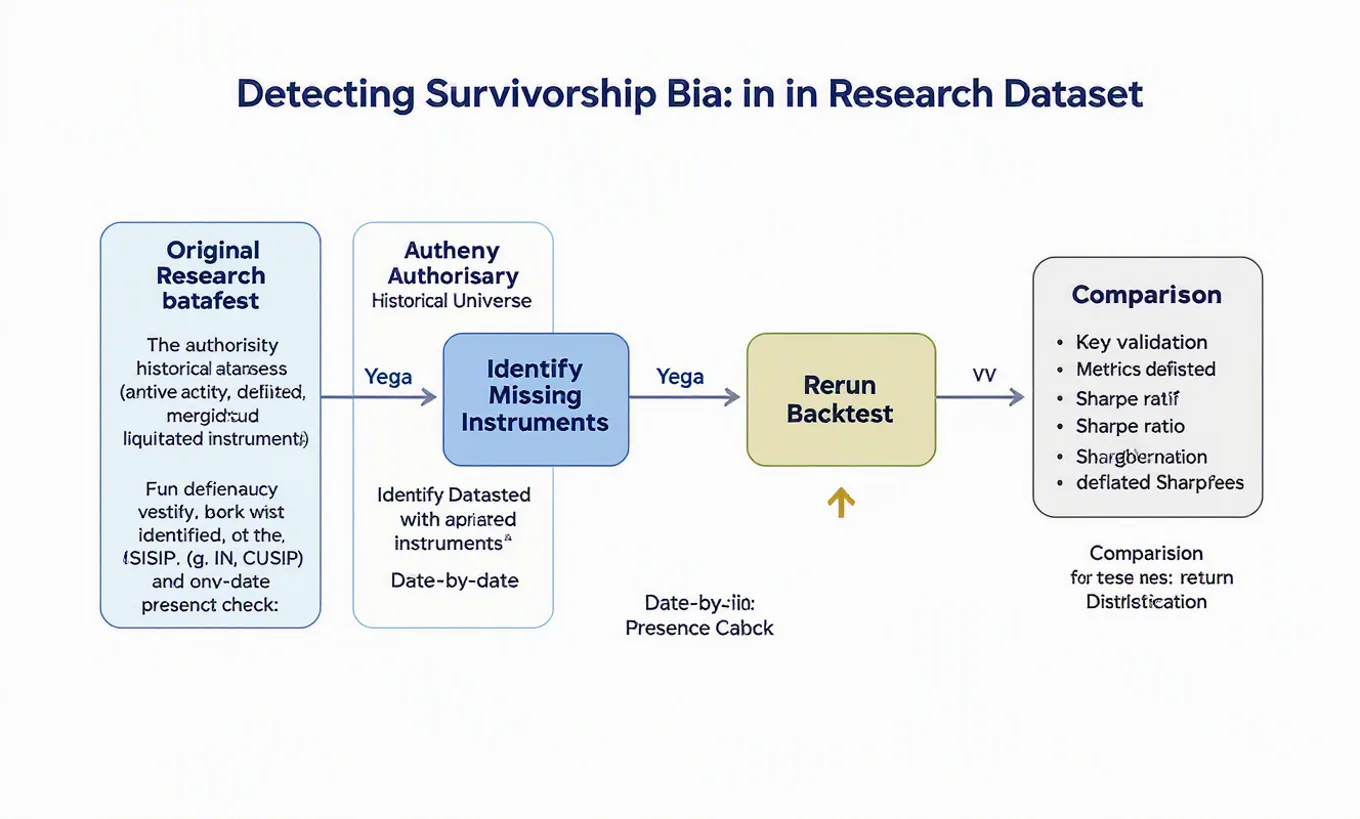
Survivorship bias appears when a backtest dataset contains only instruments that still exist at the end of the sample, while omitting securities that were delisted, merged away, liquidated, or otherwise disappeared during the test window. For quantitative traders, that matters because validation metrics can look materially different when the historical universe excludes the names that failed or stopped trading. The practical task is therefore not just to define survivorship bias, but to detect whether it is present in the data and then measure how much it changes the evaluation of a strategy.
A workable detection process starts with the universe definition. In strategy validation, Sonar emphasizes that validation is only as credible as the assumptions embedded in the data and testing process, and that dataset construction is itself part of model risk rather than a neutral preprocessing step. Applied to survivorship bias, that means the first question is: what instruments were eligible at each point in time, not which instruments are visible in today’s vendor snapshot. If the dataset is assembled from currently listed symbols only, or from a static constituent file taken after the backtest period, that is a warning sign that the historical universe may already be filtered by survival.
From there, the detection procedure is a cross-reference exercise. Build a time-indexed inventory of every instrument present in the research dataset across the backtest horizon. Then compare that inventory against an authoritative historical list for the same market and dates that includes inactive and delisted names. The purpose is to identify symbols or identifiers that should have appeared during the sample but do not. Because tickers can be recycled or changed, the comparison should be done using persistent identifiers where possible, and checked date-by-date rather than only at the beginning or end of the sample. If the external universe contains instruments that were tradable during the historical period but your research data omits them entirely or truncates them before delisting, that is direct evidence of survivorship bias.
The next step is to quantify the omission. Sonar’s strategy-validation material stresses comparing outcomes under different validation assumptions instead of trusting a single headline statistic. In this context, construct two versions of the test: the original dataset and a corrected dataset that re‑includes the missing inactive instruments and their full histories up to delisting or termination. Then recompute the same strategy and diagnostics on both versions. The important outputs are not just average return measures, but the full distribution of outcomes and risk‑adjusted metrics. At minimum, compare the return distribution, volatility‑sensitive summary statistics, and the Sharpe ratio under both datasets.
A stronger comparison also includes the deflated Sharpe ratio. Sonar’s glossary describes the deflated Sharpe ratio as a way to discount an observed Sharpe ratio for selection effects and non‑normality, helping distinguish apparently strong results from those that may be explained by multiple testing or favorable noise. That matters here because survivorship bias can inflate the apparent quality of a strategy before any additional overfitting adjustment is applied. If adding dead or delisted instruments reduces both the ordinary Sharpe ratio and the deflated Sharpe ratio, that is evidence that the original result benefited from a biased universe as well as from the usual model‑selection risks.
The same logic connects to Sonar’s backtest overfitting audit. The audit framework focuses on whether performance survives more skeptical validation once the researcher accounts for testing choices and optimistic assumptions. Survivorship bias is one of those optimistic assumptions. A strategy that appears robust on a survivors‑only dataset may look much less convincing when the missing instruments are restored, and any overfitting audit should be interpreted in light of that data‑construction choice. In practice, survivorship bias detection therefore belongs in the same checklist as parameter sensitivity, multiple‑testing controls, and out‑of‑sample validation.
Operationally, the procedure can be written as a short audit:
1. Define the intended historical universe rules for each date in the backtest. 2. Extract the actual instrument list present in the research dataset for those dates. 3. Obtain an authoritative historical universe that includes inactive, merged, and delisted instruments. 4. Match the two universes by persistent identifier and date. 5. Flag missing instruments, missing terminal histories, and symbol‑history inconsistencies. 6. Rebuild the dataset including the omitted inactive instruments. 7. Re‑run the backtest unchanged. 8. Compare return distribution, Sharpe ratio, and deflated Sharpe ratio between the original and corrected datasets. 9. Treat any material degradation as evidence that survivorship bias was affecting the original result.
For a strategy developer, the key takeaway is that survivorship bias is detectable only by explicitly checking for the presence of instruments that disappeared during the sample. If you do not verify that delisted or defunct names are included, you are not really testing the historical universe your model would have faced. And if you do not compare the original results with a corrected, dead‑instrument‑inclusive dataset, you cannot measure how much that omission affected validation metrics.
Drafted with AI assistance from cited sources. Reviewed and approved by Sonar Sciences Quant & Research Team.