How to choose an out-of-sample split
5 min read
An out-of-sample split improves validation only if it preserves independence between research and evaluation. Hold out enough data to capture meaningful unseen variation, prefer time-based splits as the primary defense against leakage, use regime analysis to test robustness across market conditions, and treat each holdout as spent once it has influenced strategy changes.
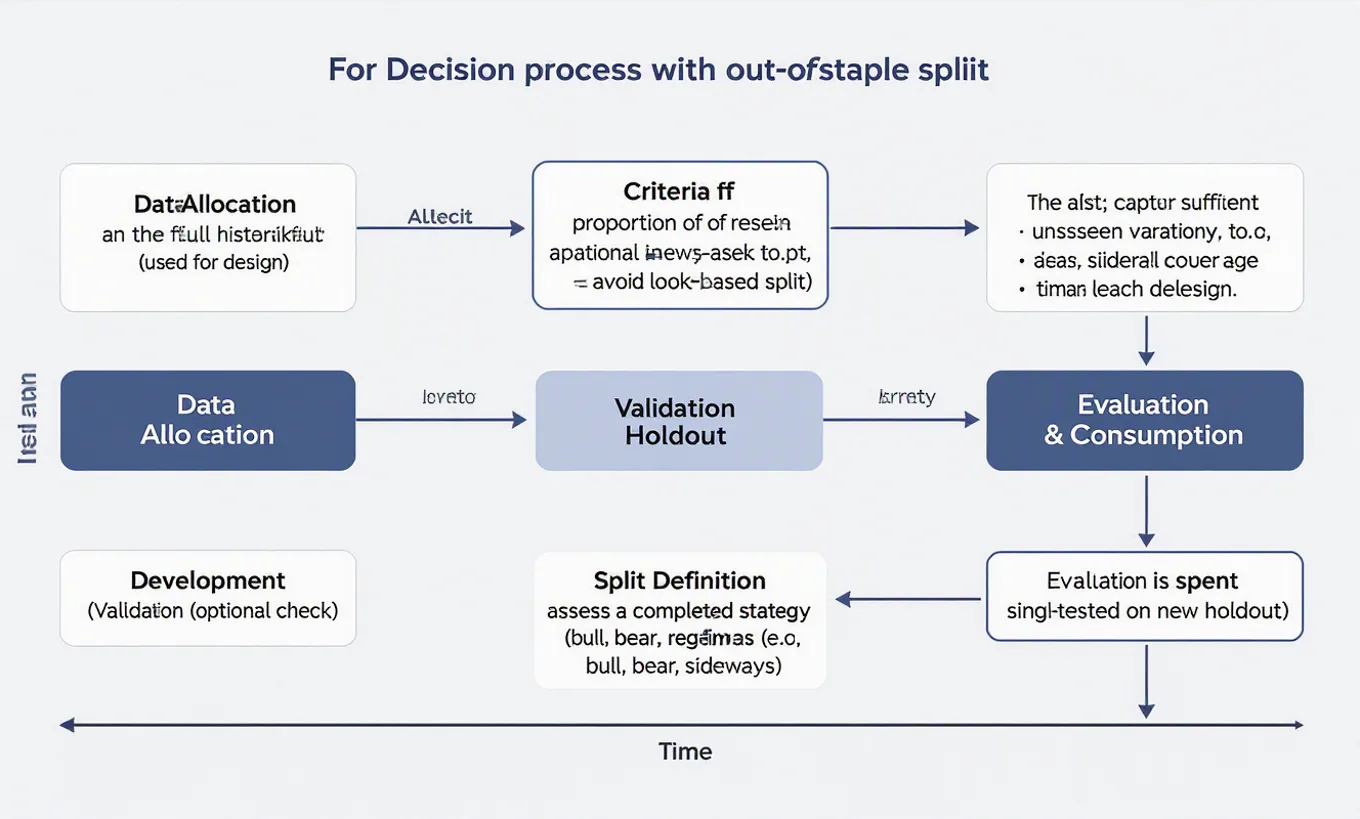
Out-of-sample testing is the practice of reserving part of a dataset for evaluation after a strategy has been designed on the remaining data. Its purpose is to check whether a strategy that looked promising in development still behaves credibly on unseen data. A useful split has three parts to decide: how much data to hold out, how to define the boundary between development and evaluation, and how strictly to preserve the independence of the holdout.
The amount of data to hold out is a tradeoff. A larger holdout gives a more informative test because it contains more unseen observations. A smaller holdout leaves more data for research and parameter selection. The right choice depends on the stability of the strategy, the length of the sample, and the number of degrees of freedom used in development. The Sonar Sciences strategy validation material emphasizes that validation quality depends not just on raw backtest results but on how much opportunity the research process had to overfit. In that framework, out-of-sample evidence is strongest when the holdout is large enough to represent market variation that the development set did not already absorb, but not so large that the in-sample segment becomes too small to specify the model sensibly.[1]
When performance is evaluated after many trials, ordinary Sharpe ratios can be misleading because repeated selection inflates apparent quality. The deflated Sharpe ratio is designed to adjust observed Sharpe ratios for selection effects and non-normality. In practice, this means the usefulness of a holdout split is tied to how much multiple testing occurred before the final evaluation. If a researcher explored many variants on a small development sample and then checked a narrow holdout, the final statistic can still look stronger than it should. A larger and cleaner holdout helps, but it does not erase the need to discount performance for the breadth of the search. Sonar Sciences defines the deflated Sharpe ratio precisely as a correction that asks whether an observed Sharpe ratio remains significant after accounting for the number of trials and the distributional properties of returns.[3]
The split itself is usually time based. In a time-based split, the strategy is developed on earlier data and tested on later data. This respects the chronological structure of trading and matches the way signals would be used in reality. It is the default because it prevents future information from leaking into model design. A time-based split is especially appropriate when the strategy depends on lagged predictors, execution assumptions, or market structure features that evolve over time.[1]
A regime-based split answers a different question. Instead of drawing the boundary at a calendar point alone, it separates data by market condition, such as high volatility versus low volatility, trending versus mean-reverting periods, or distinct macro environments. The value of this approach is diagnostic. It reveals whether a strategy is robust across the kinds of conditions it may encounter or whether its apparent edge is concentrated in one environment. Sonar Sciences discusses validation through the lens of overfitting risk and emphasizes that robustness must be tested against variation that matters economically, not just random partitions of the same history.[1][2]
Time-based and regime-based splits are not interchangeable. A time-based split is the primary safeguard against look-ahead bias because it preserves temporal order. A regime-based split is a stress test for generalization across conditions. For many systematic strategies, the practical solution is to start with a strict time-based holdout and then inspect performance by regime within that structure. That keeps chronology intact while showing whether the model relies too heavily on one state of the world. The Sonar Sciences backtest overfitting audit is built around the idea that validation should measure how fragile a result is to alternative slices and repeated selection, which is exactly the concern that regime analysis can expose.[2]
The single most important rule is that a holdout is spent once used. A holdout is meant to simulate unseen future evidence. If it influences model revisions, parameter changes, feature choice, or strategy selection, it is no longer unseen. At that point it has become part of the research process and has lost its status as an independent test. Sonar Sciences treats this as a core issue in overfitting audits: every additional peek increases the chance that a strategy is being tuned to noise rather than signal.[1][2]
Reusing a holdout creates bias because it turns evaluation into selection. Even if each change seems modest, the cumulative process favors models that happen to fit the holdout idiosyncrasies. The result is inflated performance statistics and overstated confidence. This is the same logic behind the deflated Sharpe ratio. Once many alternatives have been tried, the observed best result must be discounted because some of its strength can arise from search rather than genuine predictability.[2][3]
This rule has a practical implication. If a holdout has been consulted and the strategy changes in response, a fresh holdout is needed for the next independent test. If no fresh data are available, the researcher should treat the prior holdout as consumed and downgrade the evidential strength of the result. In other words, the split is not just a partition of rows. It is a protocol for preserving independence.[1][2]
Choosing an appropriate out-of-sample split therefore means aligning the split with the question being asked. Use enough holdout data to expose the strategy to meaningful unseen variation. Use a time-based split to preserve realism and avoid information leakage. Use regime analysis to test whether apparent robustness depends on a narrow market state. And once the holdout has informed a decision, treat it as used up. These steps improve validation reliability because they reduce the gap between a backtest selected in research and a strategy assessed on genuinely unseen evidence.[1][2][3]
Drafted with AI assistance from cited sources. Reviewed and approved by Sonar Sciences Quant & Research Team.