How to choose a benchmark for a strategy
4 min read
A fair benchmark for a quant strategy should match the strategy’s investment universe and broad exposures; otherwise, the comparison can mistake exposure differences for skill. The Sonar validation framework links benchmark discipline with overfitting audits and the deflated Sharpe ratio.
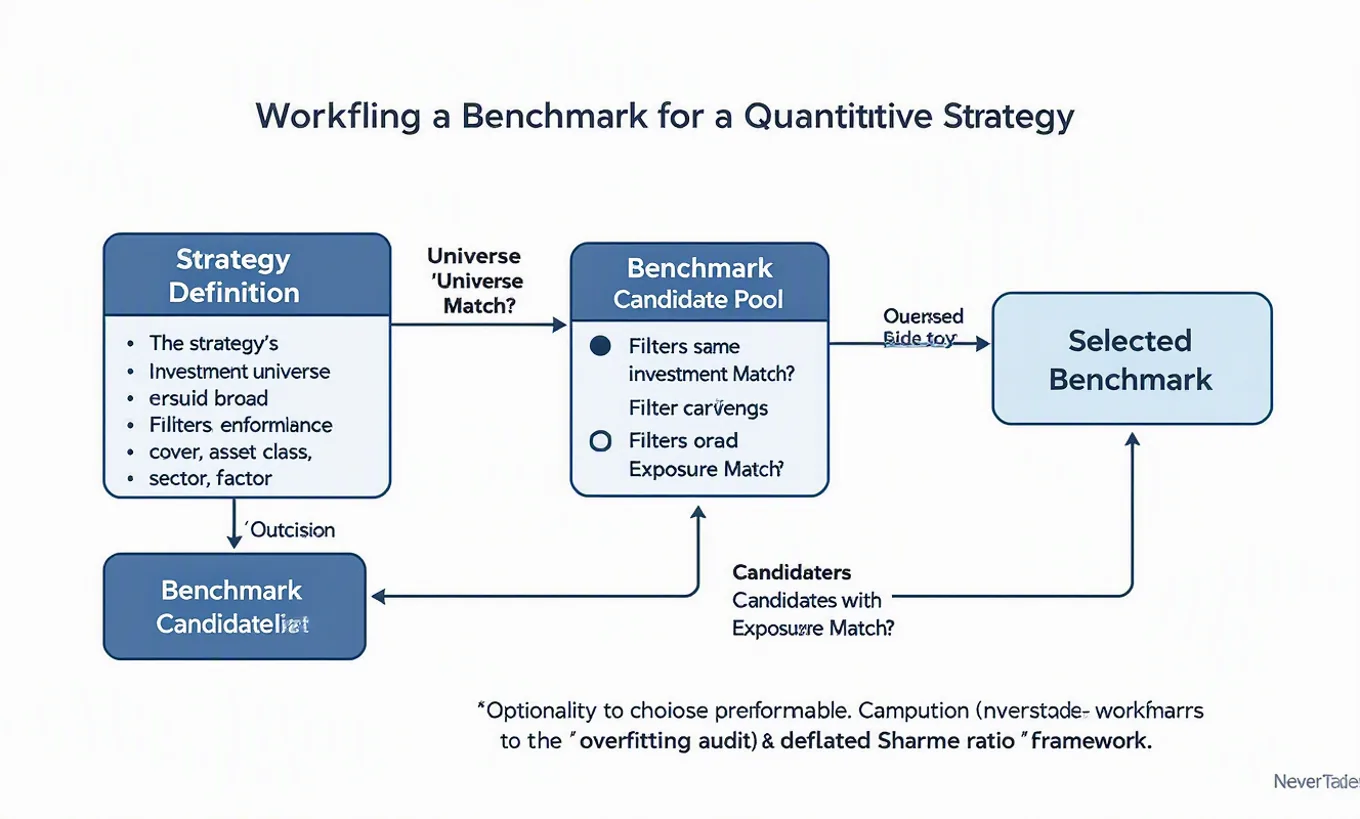
A benchmark is only useful if it answers the same question your strategy is trying to answer. For a quantitative strategy, that usually means the benchmark should reflect the same investment universe and the same broad exposures the strategy takes. If it does not, any comparison can confuse exposure differences with true strategy skill.
Sonar’s strategy-validation research emphasizes that backtest evaluation should focus on whether a result is robust, economically meaningful, and distinguishable from noise. In that context, benchmark choice matters because a misaligned benchmark can make a strategy look better or worse for reasons unrelated to the decision rule being tested. A strategy trading a narrow universe, a specific asset class, or a persistent factor tilt should not be judged against a broad market series that embeds different risks and opportunities. The comparison should isolate what the strategy adds beyond simply holding the assets or exposures it already resembles.
This is where buy-and-hold becomes important. Buy-and-hold is often treated as a trivial baseline, but an aligned buy-and-hold benchmark can be a demanding test. If a strategy’s universe and exposures are matched properly, then outperforming a passive hold of that same opportunity set is harder than outperforming a generic market index. A broad index may differ in composition, concentration, sector mix, volatility profile, or factor loadings. In that case, excess performance versus the index may partly reflect those differences rather than the strategy logic itself. By contrast, a buy-and-hold benchmark built from the same universe is closer to the true null hypothesis: what happens if the researcher does nothing except hold the assets the strategy is implicitly selecting from?
The material supports the principle that validation should reduce false discoveries from backtest design choices. The backtest overfitting audit tool is explicitly framed around the risk that repeated testing, specification search, and selective reporting can make a backtest appear stronger than it really is. An exposure-matched benchmark helps on that front because it narrows the room for accidental advantage from benchmark selection. If a researcher can choose a favorable index after seeing results, benchmark choice itself becomes another degree of freedom. Matching the benchmark to the strategy’s exposure and universe makes the test more disciplined and less vulnerable to this kind of overfitting-by-comparison.
The same logic is consistent with the glossary entry on the deflated Sharpe ratio. The deflated Sharpe ratio is presented as a way to account for non-normal returns, short sample lengths, and multiple testing when assessing whether an observed Sharpe ratio is truly exceptional. That framework is not a benchmark-selection rule by itself, but it reinforces the broader idea that evaluation should discount flattering but fragile evidence. If a strategy is compared to an easy or mismatched benchmark, the apparent edge may be overstated before one even gets to risk-adjusted statistics. Using an aligned benchmark improves the quality of the input comparison; using tools such as the deflated Sharpe ratio then helps judge whether the remaining apparent advantage is statistically credible rather than a product of luck or search.
Combined with overfitting audits and significance-aware measures such as the deflated Sharpe ratio, that benchmark discipline helps reduce the chance that a backtest looks persuasive for the wrong reasons.
Drafted with AI assistance from cited sources. Reviewed and approved by Sonar Sciences Quant & Research Team.