How long should you paper trade a strategy
5 min read
Sonar Sciences materials support the methodological case for ending paper trading based on a predefined minimum number of executed trades rather than a fixed calendar period. Their common thread is that validation quality depends on evidential sufficiency and protection against overfitting, not arbitrary elapsed time. The Deflated Sharpe Ratio especially supports the idea that confidence in performance statistics depends on the amount of underlying data.
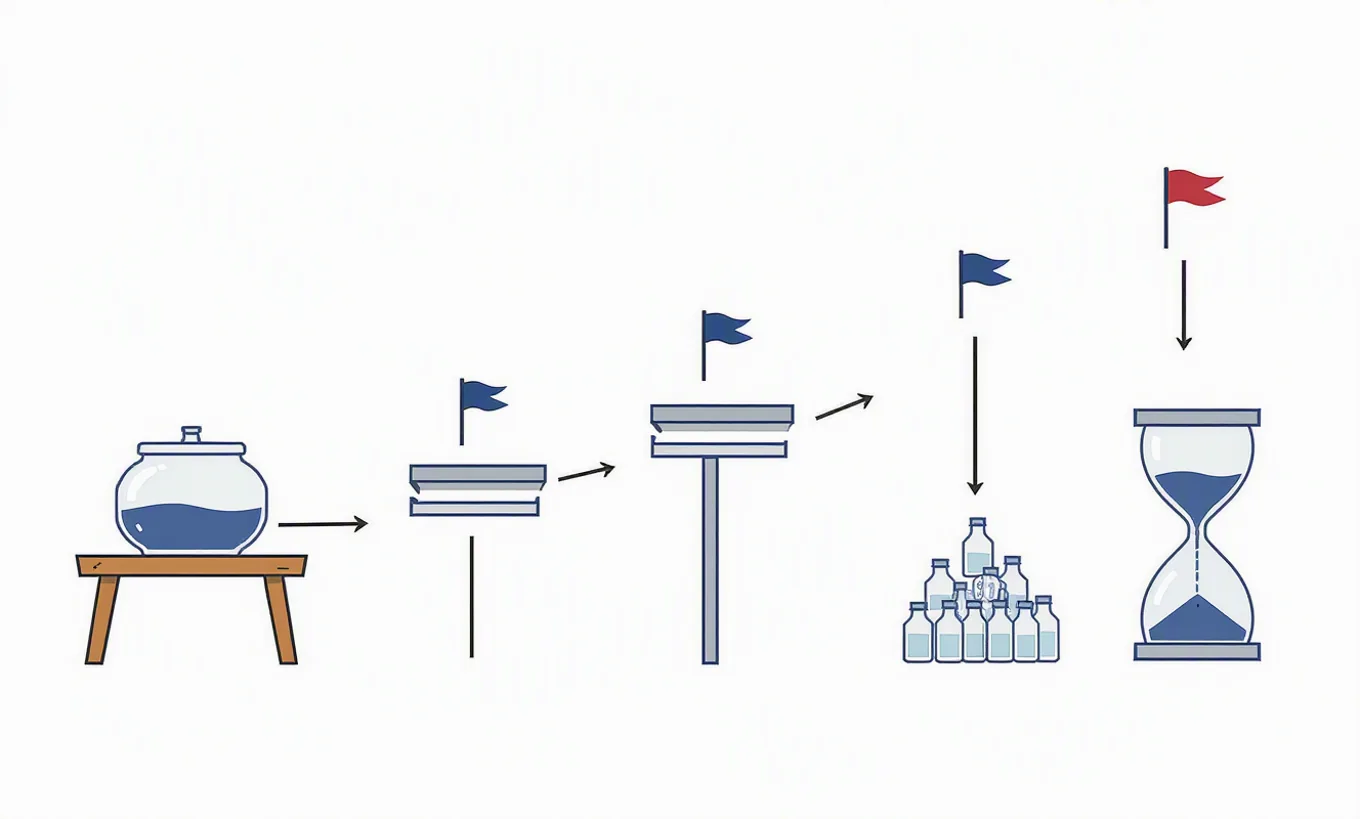
Paper trading can help answer a narrow question: does a strategy that looked coherent in research continue to behave as expected when signals are generated and orders are handled in a live-like process? The strongest support is not for a fixed number of days or months, but for using explicit validation rules tied to the amount and quality of observed evidence.
The core reason is statistical. A strategy cannot be evaluated from elapsed time alone if the amount of trading activity inside that time window varies materially. Two strategies may both be paper traded for three months, yet one may execute only a handful of trades while another produces a large sample of outcomes. Those are not equivalent validation datasets. The Sonar Sciences Fundamentals material emphasizes validation, overfitting control, and the need to distinguish genuine edge from noise rather than relying on superficial pass/fail heuristics. In that framing, a stopping rule based on observed trades is more aligned with the quantity of evidence than one based on the calendar alone.[1]
The same logic appears in Sonar's treatment of overfitting. The Backtest Overfitting Audit tool is built around testing whether in‑sample results are likely to generalize, rather than accepting a strategy because it looked good over a chosen historical span. That is relevant to paper trading because a fixed calendar window can be an arbitrary cutoff that says little about evidential strength when trade frequency is unstable across strategies or market regimes. A trade‑count rule is not a guarantee against overfitting, but it is at least connected to the size of the realized sample being evaluated.[2]
The Deflated Sharpe Ratio gives the clearest statistical support for this view. Its purpose is to assess whether an observed Sharpe ratio is likely to be meaningful after accounting for selection effects and non‑normality concerns. That directly implies a sample‑size problem: confidence in a performance statistic depends on how much data produced it. If the statistic is computed from too little realized evidence, it is easier to mistake randomness for skill. In practice, more observations narrow uncertainty around performance estimates; fewer observations leave them fragile. A stopping rule based on trade count therefore matches the structure of the metric better than a stopping rule based on elapsed time.[3]
What paper trading can actually establish
Paper trading is best understood as a forward validation layer, not proof of durable profitability. It can establish whether: - signals continue to appear in the expected market conditions, - execution logic works as designed, - operational assumptions survive contact with live data handling, - observed outcomes remain directionally consistent with the research thesis, - and the strategy still looks robust when subjected to anti‑overfitting scrutiny.[1][2]
What it cannot establish from a short or arbitrary window is that a strategy has been fully validated simply because a set number of weeks passed. Calendar time is a weak proxy because it confounds multiple variables: market regime, signal frequency, holding period, and the number of actual independent observations gathered.
Why trade count is the more defensible stopping rule
A predefined minimum executed‑trade threshold forces the researcher to specify, before observing results, how much evidence is required to make a judgment. That is valuable for two reasons.
First, it reduces discretionary stopping. If a strategy is stopped after "about two months" because the results looked encouraging or discouraging, the evaluation process itself becomes another source of selection bias. Sonar's overfitting materials are explicitly concerned with these kinds of research distortions, where process choices inflate confidence in noisy findings.[2]
Second, trade count aligns better with performance statistics. The Deflated Sharpe Ratio is used precisely because raw performance metrics can look stronger than they really are once multiple testing and limited samples are considered. If confidence in a Sharpe‑like metric depends on the quantity of underlying evidence, then stopping after a fixed number of executed trades is more coherent than stopping after a date on the calendar.[3]
Practical conclusion
The defensible conclusion is: - Paper trading should not be treated as complete simply because a fixed calendar period elapsed. - The stopping rule should be predefined and tied to evidential sufficiency. - Executed trade count is a more statistically relevant basis than calendar time because performance metrics derive their meaning from the amount of observed data, while overfitting controls require disciplined, non‑discretionary validation procedures.[1][2][3]
Calendar time can still matter for exposing a strategy to different conditions and operational realities. It can be contextual, while trade count is the more defensible primary threshold for deciding whether paper trading has generated enough evidence to evaluate the strategy at all.
Drafted with AI assistance from cited sources. Reviewed and approved by Sonar Sciences Quant & Research Team.